Aging in Place: Which Home Adaptations Should Come First?
The best starting point for aging-in-place home adaptations is the daily task that has become difficult, not the newest product on the market. Observe how the person moves through the home, identify the obstacles, and prioritize changes that address a clear need. Equipment supporting walking, transfers, or body weight should be selected and installed with appropriate professional input.
What does aging in place mean for home planning?
Aging in place means continuing to live in a familiar home as needs change. For purchasing decisions, the practical goal is to make essential routines more manageable while respecting the resident’s preferences. It does not require buying a complete set of senior-living products at once.
A useful plan connects three elements: the person’s abilities, the home’s layout, and the help available. A product can be well made yet still be unsuitable if it blocks a doorway, requires difficult cleaning, or depends on controls the resident cannot comfortably use.
Start with a walk-through of everyday routines
With the resident’s permission, review the route from bed to bathroom, the main seating area, the kitchen, and the entrance. Ask where a task feels tiring, awkward, or dependent on another person. Do not ask someone to demonstrate a movement they find unsafe simply to complete an assessment.
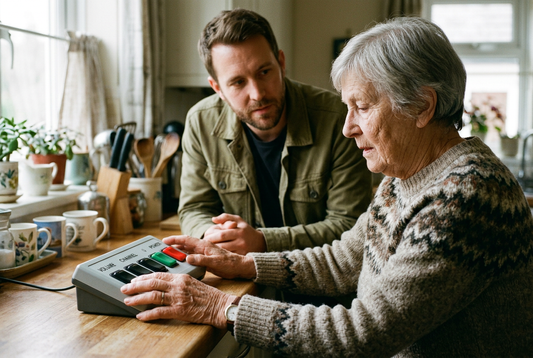
Record the activity, the obstacle, the proposed change, and any measurements needed. For example, difficulty reading a control may call for a clearer interface, while difficulty using a doorway may require a layout assessment rather than another portable device.
First priority: essential routes and usable lighting
Review furniture placement, stored items, loose cables, and the location of frequently used objects. Keep intended walking routes available rather than filling them with new equipment. Consider whether an adaptation creates a new obstruction for the resident or caregiver.
Evaluate lighting where the person reads controls, changes direction, or gets up at night. Position and glare matter alongside brightness. For automatic lights, check the activation area, how long the light stays on, and whether a manual option is easy to find. Do not assume that every sensor-based product will behave appropriately in every room.
Second priority: bathroom and toileting access
Bathroom adaptations deserve careful planning because water, confined space, and transfers can interact. Identify whether the difficulty is reaching the room, managing clothing, sitting down, standing up, washing, or cleaning equipment afterward. Different problems need different solutions.
Before selecting a shower seat, toilet aid, or support rail, compare the exact dimensions and installation conditions with the actual room. Review the manufacturer’s stated capacity and limitations. A towel rail or an ordinary piece of furniture should not be assumed to be a suitable body-weight support.
Where an adaptation involves transfers or structural supports, seek assessment and installation advice from appropriately qualified professionals. A product demonstration does not replace checking the installation surface or the user’s needs.
Third priority: seating, reaching, and everyday controls
Consider the tasks repeated throughout the day: sitting, standing, opening containers, reaching a shelf, and operating appliances. Look for manageable controls, readable labels, and comfortable access to frequently used items. Test usability under realistic conditions when doing so is appropriate and safe.
Changing where an item is stored can sometimes be more practical than purchasing a reaching aid. Similarly, simplifying a control interface may be more useful than adding remote-control features. Choose the least complicated option that adequately addresses the identified task.
How to compare products before ordering
Ask suppliers for the model identifier, instructions, dimensions, intended use, cleaning requirements, replacement-part availability, and warranty terms. Check whether accessories shown in photographs are included and whether assembly or professional installation is needed.
If a listing describes a product as certified, ask which scheme and model the claim covers. Product certification, a laboratory test report, and a supplier’s management-system certificate are different forms of evidence. Review the document’s actual scope rather than relying on a badge or headline.
Budget for installation and ownership
Include delivery, installation, routine cleaning, servicing, replacement components, and eventual removal in the budget. For powered products, also consider charging arrangements, battery replacement, and the manufacturer’s guidance for interruptions to power.
A phased plan helps avoid buying several products that compete for the same space. Address the most important identified need, confirm that the change works in everyday use, and then reassess the next priority.
Frequently asked questions
Should every room be adapted at the same time?
Not necessarily. A staged approach can be appropriate when needs and resources allow it. Essential access problems or urgent safety concerns should be assessed promptly rather than postponed to fit a purchasing schedule.
Are smart home products always the best first purchase?
No. Smart features are useful only when they solve a relevant problem and remain understandable and maintainable for the household.
Can a caregiver choose mobility or transfer equipment from measurements alone?
Measurements are useful, but they do not capture balance, strength, movement patterns, or assistance needs. Seek appropriate professional assessment for equipment that supports mobility or transfers.
A practical next step
Choose one daily routine, document the difficulty, and gather the information needed to evaluate a suitable change. Review the result with the resident after installation. Adaptation is an ongoing process, not a one-time shopping list.
For an introduction to product categories and supplier documentation, read What Are Age-Friendly Products? A Practical Buying Guide.
Tags:
Previous
What Are Age-Friendly Products? A Practical Buying Guide
Next
Age-Friendly Bathroom Products: Selection and Installation Guide